
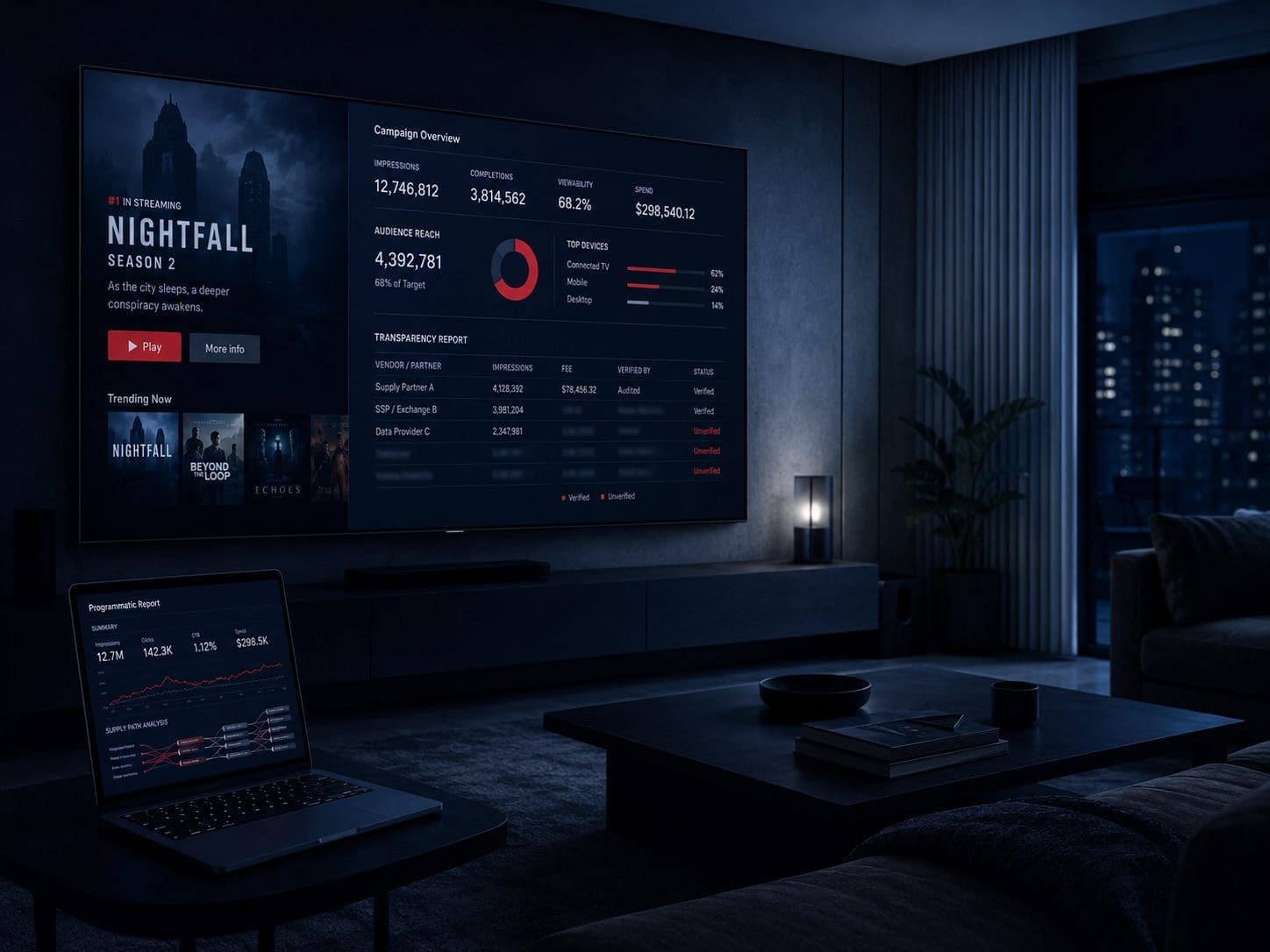
There is a question that CTV buyers have been asking for years, and the industry has been very skilled at not answering directly: what show did my ad run in?
Not the platform. Not the content category. The actual show.
In linear television, that was the starting point of any conversation. You bought a spot in a specific program, against a known audience, and the reporting confirmed it. Streaming turned that clarity into a negotiation. ‘Premium’ became a label that could mean anything from a top-tier drama to a long tail of content nobody asked for, bundled together and sold at a rate that sounded reasonable until you tried to understand what you actually bought.
The label came before the infrastructure
‘Premium streaming’ is a positioning statement, not a technical description. It does not tell a buyer which show the ad ran in, what genre the content belongs to, or how the impression traveled from seller to buyer.
For years, that gap was tolerable. Buyers were willing to extend some trust in exchange for access to an audience that had largely walked away from linear. The CPMs were high, the completion rates were strong, and the general direction felt right.
That period is over. CTV is now a mature budget line. The channel has earned its place. What it has not earned is a permanent exemption from the accountability standards applied to every other media channel.
What better measurement tools can and cannot fix
Integral Ad Science recently launched Total TV, designed to bring more granular content signals to CTV reporting: program name, genre, language, content category. The industry needs more of this.
But measurement can only report on signals that exist in the supply chain. If the content metadata is incomplete, or if the impression passed through intermediaries that altered signals along the way, the measurement report will describe a blurry object very precisely. It may have clean charts. But it is still trying to characterize something that was not fully transparent to begin with.
Measurement and supply path transparency are two separate things. Treating one as a substitute for the other leaves buyers holding a report that raises more questions than it answers.
The questions buyers are now actually asking
The conversation has shifted. The questions are more precise.
Where did the ad run? Not the platform name. The program. Was the content environment appropriate for the brand? How did the impression get there, and how many intermediaries were involved? Does the supply path make economic sense?
These are not edge-case questions from unusually demanding buyers. They are the baseline of how any competent media buyer evaluates a channel absorbing a meaningful portion of budget. Some sellers have responded with cleaner supply paths and more granular reporting. Others have relied on the complexity of the ecosystem to make these questions difficult to answer. That distinction is starting to matter more than it used to.
When CTV connects to purchase data, something changes
The integration of CTV with retail media data has genuinely moved the measurement conversation forward. When a streaming platform connects its ad delivery data to a retailer’s purchase records, a brand can observe whether the households that saw an ad actually bought something. Not inferred from a proxy metric. Observed.
Amazon Prime Video is the most developed version of this at scale. It demonstrates what CTV attribution can look like when the data infrastructure is coherent from impression to outcome. That expectation is not going back into the box.
Where Siprocal stands on this
When a campaign runs through Siprocal’s supply, the reporting shows the actual show the ad ran against, when that signal is available from the publisher. Not a content category. Not a platform label. The program.
When the signal is not available, that is reported too. Absence of information is information. Pretending otherwise does not help buyers make better decisions, and it does not help the industry build the trust it needs to sustain premium pricing over time.
Premium should be provable. If it cannot be verified, it is a pricing argument, not a quality argument.




0 Comments